Design of a Swimming Microrobot Powered by a Single Piezoelectric Bender
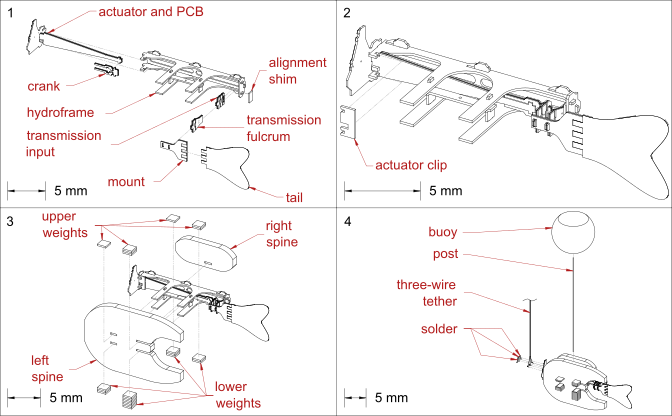
Abstract: Countless underwater robots seek to monitor aquatic environments while minimizing their impact on fragile ecosystems. At mm-scales, these systems can be used in a range of waterways, from shallow streams and rivers, to larger ponds and lakes, and navigate around large obstacles or through tight spaces in coral reefs, mangroves, or pipe systems. They can also be more readily used as platforms for biological study, as small-scale robots can more easily be integrated into bench-top characterization systems to verify hydrodynamic performance. Here, we present a new robotic platform, the Daniobot, a 16.5 mm body length (BL) microrobotic fish that is capable of achieving top speeds of 2.84 BL/s. At 23.8 mm total length (TL), Daniobot is, to the best of our knowledge, the smallest fish-inspired robot propelled by onboard actuators. We present the design, fabrication, and assembly of this robot as well as detailed position and velocity results at varying tail amplitudes and frequencies, and compare their trends to a simple analytical model. This design uses a single PZT bimorph actuator operating at 175 V, enabling future untethered experiments.
Paper: Design of a Swimming Microrobot Powered by a Single Piezoelectric Bender
Proceedings published in IEEE RSJ.
Poster presented in IROS, 2025.